Recent Articles

Wednesday, September 22, 2010

Honda Small Hybrid Sports Concept, 2007

Honda Small Hybrid Sports Concept, 2007


Honda Small Hybrid Sports Concept, a design study model, demonstrates a unique fusion of advanced environmental technology, exciting styling and fun-to-drive characteristics.
The Small Hybrid Sports Concept is conceived around a front-wheel drive, small car platform and is powered by a Honda IMA 4-cylinder petrol/electric hybrid system driving through a CVT transmission. It explores the idea that a car can have a low environmental impact yet still deliver all the driving enjoyment expected of a compact sports car.

The aerodynamic design is characterised by curvaceous and contoured surfaces contrasting with sharp "folded" edges. The short front and rear overhangs, together with wheelarches that wrap tightly around large wheels, further enhance the dramatic looks of this sports coupe. An accentuated, arrow-like nose features a full width air intake with Civic family overtones. This sweeps forward into a distinct protruding centre section complete with 'H' logo.

The Concept model's fluid lines are created by a steeply raked windscreen which extends back above the occupants' heads where it meets a one piece glass roof. This in turn flows rearwards to give the car its fastback styling, terminating in a distinctive and futuristic 3D floating glass design - a concave element which forms an additional vertical window. Further distinction is provided by a 'floating' LED tail light unit that stretches across the full width of the car. At its centre, the glass panel extends downwards and contains an illuminated 'Small Hybrid Sports' name plate.

The Hybrid Sports Concept is equipped with 165/60 section tyres mounted on 20-inch distinctive rims. Their dimension supports low rolling resistance without compromising sporty driving.
Compact external dimensions lend themselves to nimble, agile performance on the road and help to ensure a good power to weight ratio. 4000 mm in length, 1270 mm tall and 1760 mm wide, and the 2350 mm wheelbase, in conjunction with a sports suspension, delivers stable and predictable handling characteristics.
The body is particularly aerodynamically efficient and compact. Rear-facing digital cameras take the place of conventional door mirrors.

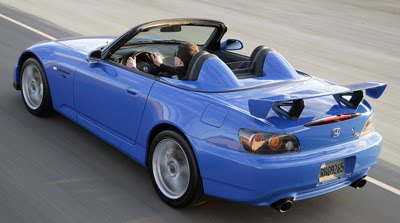
Honda S2000 CR Concept, 2007

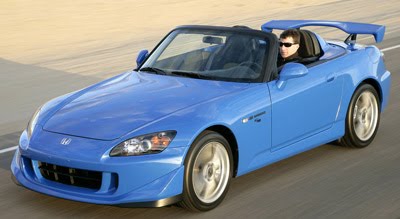
Honda S2000 CR Concept, 2007


The lighter, stiffer and more aggressive overall design is engineered to maximize the S2000's potential on a racetrack with the goal of substantially-improving track times, chassis balance and feel. The factory-tuned roadster provides highly-aggressive suspension settings, increased body and chassis rigidity, overall weight reduction and an aerodynamic body kit dialed-in for reduced lift. An aluminum hardtop replaces the convertible soft top as standard equipment.

The full-body aerodynamic package reduces lift through large and highly-tuned front and rear spoilers.
Substantial structural bracing has been added to the storage area previously occupied by the soft top, resulting in additional rigidity. The aluminum hard top replaces the soft top of the conventional S2000, resulting in an overall weight savings of approximately 90 pounds when removed (relative to the current S2000).

The exclusive interior is highlighted by unique cloth seating surfaces with yellow stitching, a unique spherical aluminum shifter and carbon fiber-style trim panels. Air conditioning and an AM/FM Stereo with CD player are optional equipment. Standard features for the S2000 include 17-inch aluminum alloy wheels, ABS and Vehicle Stability Assist (VSA). While VSA serves to effectively enhance driver control during acceleration, braking, and cornering, the system can be disabled with the touch of a button when conditions warrant it.

Widely considered the quintessential roadster-style sports car, the S2000 is the performance icon for the Honda brand and combines uncompromising racetrack-ready performance with everyday usability. The S2000 rewards driving enthusiasts with a potent 2.2-liter, 16-valve DOHC VTEC 4-cylinder engine and a precise, short throw 6-speed manual transmission, along with tenacious handling and a perfect 50/50 weight balance.

The renowned high-revving engine delivers 237 horsepower at 7,800 rpm and 162 lb-ft. of torque at 6,800 rpm. Perfectly complimenting the engine's output characteristics is a compact, longitudinally-mounted, close-ratio 6-speed manual transmission that features a direct linkage for precise shifting and quick throws. Combined with a front and rear double wishbone suspension, precise electric power steering, and a torque-sensing limited slip differential, the end result is a complete, no compromise, performance package for the enthusiast driver.

Thursday, September 2, 2010

Lexus IS 350, 2009

Lexus IS 350, 2009


Inside the Lexus IS,
Lexus enhanced form and function with a revised instrument panel center cluster. The paddle shifters now function in D mode, and some controls have been changed for improved convenience. The rear seat headrests are now foldable to aid rear visibility. New interior colors include Ecru (replacing Cashmere) and Light Gray (replacing Sterling), both accented by new contrast stitching on the seats, door panels, and console lid.

Engine/Transmission/Drivetrain/Performance
The 2009 Lexus IS line offers three models: The rear-wheel-drive Lexus IS 350, the rear-drive Lexus IS 250 and an all-wheel drive Lexus IS 250. The IS 250's 2.5-liter V6 engine delivers 204 horsepower at 6,400 RPM and 185 lb.-ft. of peak torque at 4,800 rpm. The Lexus IS 350's 3.5-liter V6 delivers 306 horsepower at 6,400 RPM along with 277 lb.-ft. of torque at 4,800 rpm and can accelerate the car from zero-to-60 mph in just 5.3 seconds. Both engines use aluminum cylinder blocks and heads and employ dual Variable Valve Timing with intelligence (VVT-i), which controls timing on both the intake and exhaust camshafts.

A direct-type fuel-injection system provides a cooling effect in the cylinders, enabling the high compression needed to extract maximum energy from the fuel. Aside from its larger displacement, the 3.5-liter V6 differs chiefly in that it augments the direct fuel injection with port fuel injectors. In light- and medium-load conditions, these additional injectors help produce a precise burn, increasing power and efficiency. A dual exhaust system reduces backpressure at higher engine speeds. All 2009 Lexus IS models meet the Ultra-Low Emission Vehicle II (ULEV II) certification

Chassis/Body/Suspension/Tires/Brakes
The Lexus IS is engineered to provide for a sporty driving experience. Its double-wishbone front suspension features a high-mount upper control arm, and the lower arm uses a large, liquid-filled bushing at the rear to minimize vibration and harshness. The multilink rear suspension emphasizes precise control of geometry in all dynamic conditions, helping make the Lexus IS sport sedans ultra-stable for confident driving. High-strength steel and aluminum suspension components reduce unsprung weight, helping the Lexus IS remain stable on bumpy surfaces and improving ride comfort.

Safety/Security Features
Passive-safety technology in the Lexus IS begins with a reinforced passenger compartment that helps protect the occupants with front- and rear-crush structures. Seatbelt pre-tensioners and force limiters are used for the front and outboard rear seats.

In addition to the dual-front airbags and front seat-mounted side airbags, the Lexus Supplemental Restraint System (SRS) for the Lexus IS includes side-curtain airbags that extend from A-pillar to C-pillar, and a knee airbag for both the driver and the front passenger. Advanced dual-stage front airbags are designed to deploy at one of two speeds, according to impact force. The driver's front airbag also includes an extra low stage designed to deploy based, in part, on the seat's position on its track. The front passenger airbag features two chambers, creating an indentation in the center impact area that helps to disperse the force of the bag.

Luxury/Comfort/Convenience
Standard amenities for the Lexus IS models include 10-way power front seats, dual-zone automatic climate control with rear-seat vents and a pollen filter (plus a smog filter on Lexus IS 350), power moonroof with one-touch open/close and seven open-position settings, manual tilt-and-telescoping steering wheel, all power windows with automatic up/down feature and jam protection, and an auto-dimming rear-view mirror. The Lexus IS 250 AWD model in addition features standard heated, leather-trimmed seats.

Luxury Options
A Premium Plus Package that is optional for all Lexus IS models includes wood trim, perforated leather seating trim and heated and ventilated front seats. The comprehensive "Sport" and "Luxury" option packages also include three-position memory for seats, steering wheel and outside mirrors, rain-sensing wipers, power tilt and telescopic steering column and auto-dimming outside mirrors.

Exterior Design
The Lexus IS sedans show a strong family resemblance to the Lexus GS models while establishing their own distinctively sporty identity. A notably wide stance and long wheelbase, coupled with tightly drawn bodywork, give the Lexus IS an athletic, road-hungry yet sophisticated style. Carefully shaped body contours, a subtle ducktail-curved trunk lid and "air kick" tail lamps contribute to a low 0.28 coefficient of drag (Cd).

Interior Design
The Lexus IS models' luxurious cabin features intelligently designed displays and controls that are easy to see and use. Bright, clear Optitron gauges and smartly integrated metallic trim, or available Bird's-eye Maple trim, help create an elegant yet sporty environment. Premium interior materials and meticulous attention to detail convey the Lexus identity.